

Actualités
et publications

Découvrez en temps réel toute l’actualité des EBMD en France, avec un focus sur leurs applications en médecine d’urgence :

  • Événements professionnels : congrès, webinaires et rencontres à ne pas manquer.
  • Publications et ressources : articles, guides et retours d’expérience.
  • Actualités du réseau : nos actions et leur impact sur la discipline.


Un espace dynamique pour suivre l’évolution de la pratique et contribuer à son essor.

4 février 2026 : Publication au Journal Officiel d’un arrêté ministériel sur les examens de biologie médicale délocalisée (EBMD) – Une avancée majeure, mais des défis à relever !!

Le 4 février 2026, un arrêté ministériel modifiant les conditions de réalisation des prélèvements et analyses d’examens de biologie médicale hors laboratoire a été publié au Journal Officiel. Ce texte, qui encadre la pratique des EBMD, marque une étape décisive pour leur déploiement en France.

Un impact direct sur la prise en charge des patients

A l’échelle des territoires, l’évolution des pratiques de soins hors services hospitaliers est nécessairement en lien avec les pratiques de la médecine hospitalière, et plus particulièrement les services médicaux d’urgence (pré et intra-hospitaliers). Ces derniers, terrains d’application privilégiés des EBMD, pourront bénéficier d’outils indispensables pour un diagnostic rapide et précis en situation critique.

Les EBMD : un enjeu de santé publique

Pour que ces examens trouvent toute leur place dans les pratiques médicales d’urgence, leur développement doit être ambitieux, structuré et adapté à leurs spécificités. Cela implique :

  • Une rationalisation de la liste des examens,
  • La démonstration de leur intérêt médico-économique,
  • La production de preuves scientifiques solides.

Le rôle clé du réseau POCER

Dans ce contexte, le réseau POCER s’impose comme un acteur central. En fédérant les professionnels de la médecine d’urgence et de la biologie délocalisée, il :

  • Stimule des projets de recherche innovants,
  • Soutient la production de données probantes,
  • Accompagne la transition vers une médecine d’urgence plus réactive et efficace.

Un engagement fort pour l’avenir

Le réseau POCER s’engage à faire des EBMD un pilier des pratiques médicales d’urgence, au service des patients et des professionnels de santé.
18 Novembre 2025 : Réunion de lancement du réseau POCER

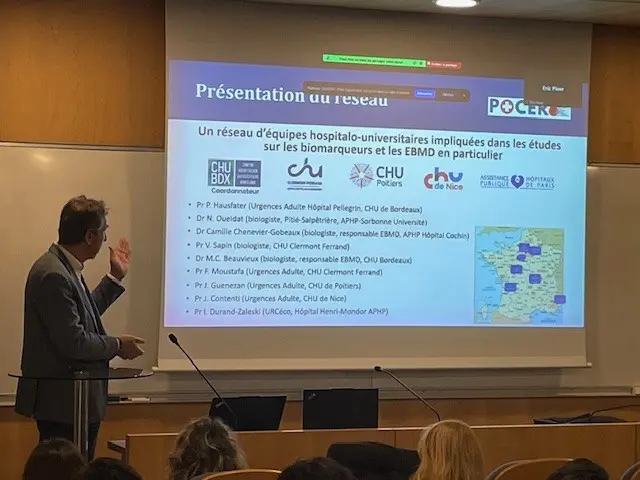
Le 18 novembre 2025, le réseau POCER a officiellement été lancé lors d’une réunion rassembleuse, réunissant plus de soixante participants issus de l’industrie du diagnostic, de la médecine d’urgence, de la biologie médicale et de l’Agence Nationale de la Recherche (ANR). Cet événement, organisé en présentiel et à distance, a marqué le coup d’envoi d’une collaboration nationale inédite dédiée à l’innovation et à la recherche en biologie médicale délocalisée dans les services médicaux d’urgence.

L’engouement des participants s’est traduit par des échanges riches et variés, ponctués de nombreuses questions et de discussions prometteuses autour de futurs projets collaboratifs. Cette journée a ainsi posé les bases d’une dynamique collective au service de l’amélioration des pratiques médicales en situation d’urgence.

Un grand merci à tous les participants pour leur présence et leur contribution à cette belle aventure humaine et scientifique !

Image accueil Pocer à Bordeaux
18 Novembre 2024 : POCER lauréat de l’appel à projet de l’ANR « Réseaux d’investigations cliniques – dispositifs médicaux et dispositifs de diagnostic in-vitro ».

Face aux défis réglementaires et aux difficultés rencontrées par les acteurs français des dispositifs médicaux, l’appel à projets de l’ANR « Réseaux d’investigations cliniques » représente une véritable opportunité pour dynamiser la recherche clinique. Parmi les lauréats, POCER se distingue en structurant un réseau innovant dédié aux Examens de Biologie Médicale Délocalisés en structure de médecine d’urgence, avec pour ambition d’accélérer le développement, la validation et la mise sur le marché de dispositifs médicaux sûrs et performants.

Lancé en 2023, l’appel à projets « Réseaux d’investigations cliniques – dispositifs médicaux et dispositifs médicaux de diagnostic in vitro » vise à structurer la recherche clinique en France en finançant la création et le développement de réseaux d’investigations, publics et privés, dédiés aux dispositifs médicaux ainsi qu’aux dispositifs médicaux de diagnostic in vitro.

Cet appel à projets répond aux enjeux majeurs révélés ou accentués par la crise sanitaire, ainsi qu’à l’application des nouveaux règlements européens MDR 2017/745 et IVDR 2017/746, qui imposent des exigences renforcées en matière de qualité, de sécurité et de performance des dispositifs. Les fabricants de dispositifs médicaux doivent désormais relever des défis importants pour garantir la conformité de leurs produits à ces normes strictes.

Malgré un écosystème de recherche et d’innovation reconnu et très dynamique, la France peine à capitaliser pleinement sur son marché intérieur. Face à ces constats, cet appel à projets apparaît comme une solution structurante pour surmonter les freins actuels et dynamiser l’innovation dans le secteur des dispositifs médicaux en France.

Au total, ce sont six projets qui ont été sélectionnés fin 2024 dans le cadre de l’appel à projets de l’ANR avec pour objectifs de : 
✅ Favoriser la réalisation d’études cliniques (pré ou post marquage CE) en soutenant les promoteurs dans le développement, la conception et la conduite de ces études ;
✅ Créer des passerelles concrètes entre hôpitaux, industriels et start-ups pour encourager des projets collaboratifs et accélérer l’innovation ;
✅ Renforcer l’attractivité des réseaux français d’investigations cliniques et améliorer leur positionnement sur les appels à projets européens

Voir le communiqué de presse du CHU de Bordeaux.

Impact of multiplex PCR point-of-care platform implementation for respiratory pathogen detection in an emergency department with high daily patient volume

Benjamin Bigaud, Nicolas Marjanovic, Luc Deroche, Bertrand Drugeon, Marvin Piot, Nicolas Leveque, Olivier Mimoz, Jérémy Guenezan

Impact of point-of-care multiplex PCR for Mycoplasma pneumoniae community-acquired pneumonia in the emergency department

Jérémy Guenezan, Luc Deroche, Nicolas Marjanovic, Mélyne Piton, Bertrand Drugeon, Benjamin Bigaud, Martin Billaud, Nicolas Leveque & Olivier Mimoz

Design and rationale of the HARTc 2.0 trial: A multicenter randomized controlled study on the impact of point-of-care high-sensitivity cardiac troponin-I testing in prehospital acute coronary syndrome triage on diagnosis and cost-effectiveness

Van der Lande, Anne Catherine M. H.; Diederiks, Nina M.; de Koning, Enrico R.; Bosch, Jan; Romijn, Fred P. H. T. M.; Van der Loo, Wouter P. M; Van den Akker – Van Marle, M. Elske; Dehnavi, Reza Alizadeh; Tietge, Wouter J.; Mertens, Bart J. A.; Jukema, J. Wouter; Cobbaert, Christa M.; Schalij, Martin J.; Boogers, Mark J.

Potential length of stay reductions from emergency department use of a point‐of‐care high‐sensitivity cardiac troponin assay: Pilot findings from Australia’s first cardiac emergency department

Meek, Robert; Hayden, Georgina; Lu, Zhong X; Damianopoulos, Adam; Cullen, Louise; Kumarakurusingham, Evan; Pathirana, Pavith; Than, Martin; Pickering, John W; Doery, James; Duong, Alex; Egerton‐Warburton, Diana

Pre-Hospital Point-of-Care Troponin: Is It Possible to Anticipate the Diagnosis? A Preliminary Report

Lazzari, Cristian; Montemerani, Sara; Fabrizi, Cosimo; Sacchi, Cecilia; Belperio, Antoine; Fantacci, Marilena; Sbrana, Giovanni; Ognibene, Agostino; Zanobetti, Maurizio; Nocentini, Simone

Performance evaluation of the LumiraDx quantitative microfluidic point-of-care CRP test

Ellis, Jayne; Harnett, James; Cameron, Gregor; Moss, Phil; Gray, Alasdair

Chest Pain Management Using Prehospital Point-of-Care Troponin and Paramedic Risk Assessment

Dawson, Luke P.; Nehme, Emily; Nehme, Ziad; Zomer, Ella; Bloom, Jason; Cox, Shelley; Anderson, David; Stephenson, Michael; Ball, Jocasta; Zhou, Jennifer; Lefkovits, Jeffrey; Taylor, Andrew J.; Horrigan, Mark; Chew, Derek P.; Kaye, David; Cullen, Louise; Mihalopoulos, Cathrine; Smith, Karen; Stub, Dion

Single High-Sensitivity Point-of-Care Whole-Blood Cardiac Troponin I Measurement to Rule Out Acute Myocardial Infarction at Low Risk

Apple, Fred S.; Smith, Stephen W.; Greenslade, Jaimi H.; Sandoval, Yader; Parsonage, William; Ranasinghe, Isuru; Gaikwad, Niranjan; Schulz, Karen; Stephensen, Laura; Schmidt, Christian W.; Okeson, Brynn; Cullen, Louise; SAMIE Investigators

Point-of-care high-sensitivity troponin-I analysis in capillary blood for acute coronary syndrome diagnostics

Bruinen, Anne L.; Frenk, Lisa D. S.; de Theije, Femke; Kemper, Daniëlle W. M.; Janssen, Marcel J. W.; Rahel, Braim M.; Meeder, Joan G.; van ‘t Hof, Arnoud W. J.

Diagnostic performance of a rapid, novel, whole blood, point of care high-sensitivity cardiac troponin I assay for myocardial infarction

Gunsolus, Ian L.; Schulz, Karen; Sandoval, Yader; Smith, Stephen W.; Lindgren, Brittany; Okeson, Brynn; Apple, Fred S.

POCT-management during the first wave of Covid-19 in France. Results of a national survey leaded by the SFBC-POCT Working Group

Glady, Ludovic; Moal, Valérie; Benz-De Bretagne, Isabelle; Bouvier, Damien; Di Giovanni, Flore; Chenevier-Gobeaux, Camille; Jeannesson, Elise; Jolly, Emilie; Kadi, Habiba; Oueidat, Nathalie; Pernet, Pascal; Pieroni, Laurence; Poupon, Carole; Toussaint-Hacquard, Marie; Dubos, Mickaël; Martinel, Isabelle; Chauzit, Emmanuelle; Beauvieux, Marie-Christine

Prehospital troponin as a predictor of early clinical deterioration

Martín-Rodríguez, Francisco; Sanz-García, Ancor; Castro-Portillo, Enrique; Delgado-Benito, Juan F.; Del Pozo Vegas, Carlos; Ortega Rabbione, Guillermo; Martín-Herrero, Francisco; Martín-Conty, José Luis; López-Izquierdo, Raúl

Determination of sex-specific 99th percentile upper reference limits for a point of care high sensitivity cardiac troponin I assay

Apple, Fred S.; Schulz, Karen; Schmidt, Christian W.; van Domburg, Trees S. Y.; Fonville, Judith M.; de Theije, Femke K.

Accuracy of pre-hospital HEART score risk classification using point of care versus high sensitive troponin in suspected NSTE-ACS

van Dongen, Dominique N.; Fokkert, Marion J.; Tolsma, Rudolf T.; van der Sluis, Aize; Slingerland, Robbert J.; Badings, Erik A.; van ‘t Hof, Arnoud W.J.; Ottervanger, Jan Paul

Impact of Point‐of‐care Testing on Length of Stay of Patients in the Emergency Department: A Cluster‐randomized Controlled Study

Hausfater, Pierre; Hajage, David; Bulsei, Julie; Canavaggio, Pauline; Lafourcade, Alexandre; Paquet, Anne Laure; Arock, Michel; Durand‐Zaleski, Isabelle; Riou, Bruno; Oueidat, Nathalie

Point-of-care testing: place of France in the worldNational survey in healthcare establisments in 2019

Beauvieux, Marie-Christine; Bost, Erika; Castaing-Mouhica, Gladys; Terral, Catherine; Berthon, Nathalie; Martinel, Isabelle; Chauzit, Emmanuelle

Point-of-Care Troponin Testing during Ambulance Transport to Detect Acute Myocardial Infarction

Stopyra, Jason P.; Snavely, Anna C.; Scheidler, James F.; Smith, Lane M.; Nelson, Robert D.; Winslow, James E.; Pomper, Gregory J.; Ashburn, Nicklaus P.; Hendley, Nella W.; Riley, Robert F.; Koehler, Lauren E.; Miller, Chadwick D.; Mahler, Simon A.

Development of a needle shaped microelectrode for electrochemical detection of the sepsis biomarker interleukin-6 (IL-6) in real time

Russell, Christopher; Ward, Andrew C.; Vezza, Vincent; Hoskisson, Paul; Alcorn, David; Steenson, D. Paul; Corrigan, Damion K.

Evaluation of the capillary assay of C-reactive protein (CRP) through the lenght of consultation in pediatric emergencies and its economic impact

Roulliaud, Marine; Pereira, Bruno; Cosme, Justine; Mourgues, Charline; Sarret, Catherine; Sapin, Vincent; Caron, Nicolas; Bouvier, Damien

A prospective, multi-centre US clinical trial to determine accuracy of FebriDx point-of-care testing for acute upper respiratory infections with and without a confirmed fever

Shapiro, Nathan I.; Self, Wesley H.; Rosen, Jeffrey; Sharp, Stephan C.; Filbin, Michael R.; Hou, Peter C.; Parekh, Amisha D.; Kurz, Michael C.; Sambursky, Robert

A point-of-care microfluidic biochip for quantification of CD64 expression from whole blood for sepsis stratification

Hassan, U.; Ghonge, T.; Reddy, B.; Patel, M.; Rappleye, M.; Taneja, I.; Tanna, A.; Healey, R.; Manusry, N.; Price, Z.; Jensen, T.; Berger, J.; Hasnain, A.; Flaugher, E.; Liu, S.; Davis, B.; Kumar, J.; White, K.; Bashir, R.

Use of point-of-care testing and early assessment model reduces length of stay for ambulatory patients in an emergency department

Kankaanpää, Meri; Raitakari, Maria; Muukkonen, Leila; Gustafsson, Siv; Heitto, Merja; Palomäki, Ari; Suojanen, Kimmo; Harjola, Veli-Pekka

Point-of-care troponinT is inferior to high-sensitivity troponinT for ruling out acute myocardial infarction in the emergency department.

Ewoud Ter Avest, Anniek Visser, Bram Reitsma, Rob Breedveld, Albert Wolthuis

Addition of copeptin improves diagnostic performance of point-of-care testing (POCT) for cardiac troponin T in early rule-out of myocardial infarction — A pilot study

Vafaie, Mehrshad; Biener, Moritz; Mueller, Matthias; Abu Sharar, Haitham; Hartmann, Oliver; Hertel, Sabine; Katus, Hugo A.; Giannitsis, Evangelos

Comparison between B·R·A·H·M·S PCT direct, a new sensitive point-of-care testing device for rapid quantification of procalcitonin in emergency department patients and established reference methods – a prospective multinational trial

Kutz, Alexander; Hausfater, Pierre; Oppert, Michael; Alan, Murat; Grolimund, Eva; Gast, Claire; Alonso, Christine; Wissmann, Christoph; Kuehn, Christian; Bernard, Maguy; Huber, Andreas; Mueller, Beat; Schuetz, Philipp

Economic Analysis of Rapid and Sensitive Polymerase Chain Reaction Testing in the Emergency Department for Influenza Infections in Children

Nelson, Richard E.; Stockmann, Chris; Hersh, Adam L.; Pavia, Andrew T.; Korgenksi, Kent; Daly, Judy A.; Couturier, Marc R.; Ampofo, Krow; Thorell, Emily A.; Doby, Elizabeth H.; others

Comprehensive bedside point of care testing in critical ED patients: a before and after study

Singer, Adam J.; Williams, Justin; Taylor, Maria; Le Blanc, Deborah; Thode, Henry C.

Narrative review of primary care point-of-care testing (POCT) and antibacterial use in respiratory tract infection (RTI)

Cooke, Jonathan; Butler, Christopher; Hopstaken, Rogier; Dryden, Matthew Scott; McNulty, Cliodna; Hurding, Simon; Moore, Michael; Livermore, David Martin

Analytical evaluation of point of care cTnT and clinical performances in an unselected population as compared with central laboratory highly sensitive cTnT

Dupuy, Anne Marie; Sebbane, Mustapha; Roubille, François; Coste, Thibault; Bargnoux, Anne Sophie; Badiou, Stéphanie; Kuster, Nils; Cristol, Jean Paul

The Effect of Laboratory Testing on Emergency Department Length of Stay: A Multihospital Longitudinal Study Applying a Cross-classified Random-effect Modeling Approach

Li, Ling; Georgiou, Andrew; Vecellio, Elia; Eigenstetter, Alex; Toouli, George; Wilson, Roger; Westbrook, Johanna I.

Point-of-care testing in the overcrowded emergency department–can it make a difference?

Rooney, Kevin D.; Schilling, Ulf M.

Diagnostic Characteristics of a Clinical Screening Tool in Combination With Measuring Bedside Lactate Level in Emergency Department Patients With Suspected Sepsis

Singer, Adam J.; Taylor, Merry; Domingo, Anna; Ghazipura, Saad; Khorasonchi, Adam; Thode, Henry C.; Shapiro, Nathan I.

Comparison of D-dimer point of care test (POCT) against current laboratory test in patients with suspected venous thromboembolism (VTE) presenting to the emergency department (ED)

Sen, B.; Kesteven, P.; Avery, P.

Analytical comparison of the new point-of-care troponin T immunoassay on AQT90Flex® analyzer (Radiometer) and the high-sensitivity troponin T immunoassay on ModularE170® (Roche Diagnostics)

Monneret, Denis; Abbes, Rachel Ahmed Ben; Omarjee, Riyadh; Devilliers, Catherine; Le Manach, Yannick; Raux, Mathieu; Coriat, Pierre; Imbert-Bismut, Françoise; Bonnefont-Rousselot, Dominique

Opinion paper on utility of point-of-care biomarkers in the emergency department pathways decision making

Di Somma, Salvatore; Zampini, Giorgio; Vetrone, Francesco; Soto-Ruiz, Karina M.; Magrini, Laura; Cardelli, Patrizia; Ronco, Claudio; Maisel, Alan; Peacock, Frank W.

Diagnostic performance of four point of care cardiac troponin I assays to rule in and rule out acute myocardial infarction

Palamalai, Vikram; Murakami, MaryAnn M.; Apple, Fred S.

Measurement of natriuretic peptides at the point of care in the emergency and ambulatory setting: Current status and future perspectives

Bingisser, Roland; Cairns, Charles B.; Christ, Michael; Collinson, Paul; Hausfater, Pierre; Lindahl, Bertil; Mair, Johannes; Price, Christopher; Venge, Per

Assessment of using fingerstick blood sample with i-STAT point-of-care device for cardiac troponin I assay

Loewenstein, Devin; Stake, Christine; Cichon, Mark

Impact from point-of-care devices on emergency department patient processing times compared with central laboratory testing of blood samples: a randomised controlled trial and cost-effectiveness analysis

Asha, Stephen Edward; Chan, Adam Chiu Fat; Walter, Elizabeth; Kelly, Patrick J; Morton, Rachael L; Ajami, Allan; Wilson, Roger Denis; Honneyman, Daniel

Utility of point-of-care testing in ED triage

Soremekun, Olanrewaju A; Datner, Elizabeth M; Banh, Simon; Becker, Lance B; Pines, Jesse M

Use of a comprehensive metabolic panel point-of-care test to reduce length of stay in the emergency department: a randomized controlled trial

Jang, Ji Yeon; Shin, Sang Do; Lee, Eui Jung; Park, Chang Bae; Song, Kyoung Jun; Singer, Adam J

Point-of-Care Testing May Reduce Length of Stay but Not Emergency Department Crowding

Goodacre, Steve W.

Comparison of early biomarker strategies with the Heart Foundation of Australia/Cardiac Society of Australia and New Zealand guidelines for risk stratification of emergency department patients with chest pain

Cullen, Louise; Parsonage, William A; Greenslade, Jaimi; Lamanna, Arvin; Hammett, Christopher J; Than, Martin; Ungerer, Jacobus P J; Chu, Kevin; O’Kane, Shanen; Brown, Anthony F T

Point of Care D-Dimer Testing in the Emergency Department: A Bioequivalence Study

Perveen, Shuhana; Unwin, Danielle; Shetty, Amith Loknath

Twelve Months of Routine HIV Screening in 6 Emergency Departments in the Paris Area: Results from the ANRS URDEP Study

Casalino, Enrique; Bernot, Bruno; Bouchaud, Olivier; Alloui, Chakib; Choquet, Christophe; Bouvet, Elisabeth; Damond, Florence; Firmin, Sandra; Delobelle, Aurore; Nkoumazok, Beatrice Ename; Der Sahakian, Guillaume; Viard, Jean-Paul; Zbar, Olivier Zak Dit; Aslangul, Elisabeth; Krivine, Anne; Zundel, Julie; Ghosn, Jade; Nordmann, Patrice; Claessens, Yann-Erick; Tahi, Tassadit; Riou, Bruno; Gautheret-Dejean, Agnès; Katlama, Christine; Hausfater, Pierre; Brun-Vézinet, Françoise; Costagliola, Dominique

Cardiac troponin: a critical review of the case for point-of-care testing in the ED

Bingisser, Roland; Cairns, Charles; Christ, Michael; Hausfater, Pierre; Lindahl, Bertil; Mair, Johannes; Panteghini, Mauro; Price, Christopher; Venge, Per

Blood sample tube transporting system versus point of care technology in an emergency department; effect on time from collection to reporting? A randomised trial

Nørgaard, Birgitte; Mogensen, Christian Backer